- 903 commercial aircraft deliveries recorded between January and August 2026 marks the highest year-to-date total since 2018
- August deliveries reached their second-highest level in eight years despite a modest year-on-year decline
- The aircraft backlog stands at 17,010 aircraft, equating to nearly £391 billion in value to the UK’s economy
London (25 September 2026) – Commercial aircraft manufacturers delivered 903 aircraft during the first eight months of 2026, marking the strongest year-to-date delivery performance since 2018 and representing a 9% increase compared with the same period in 2025, according to ADS.
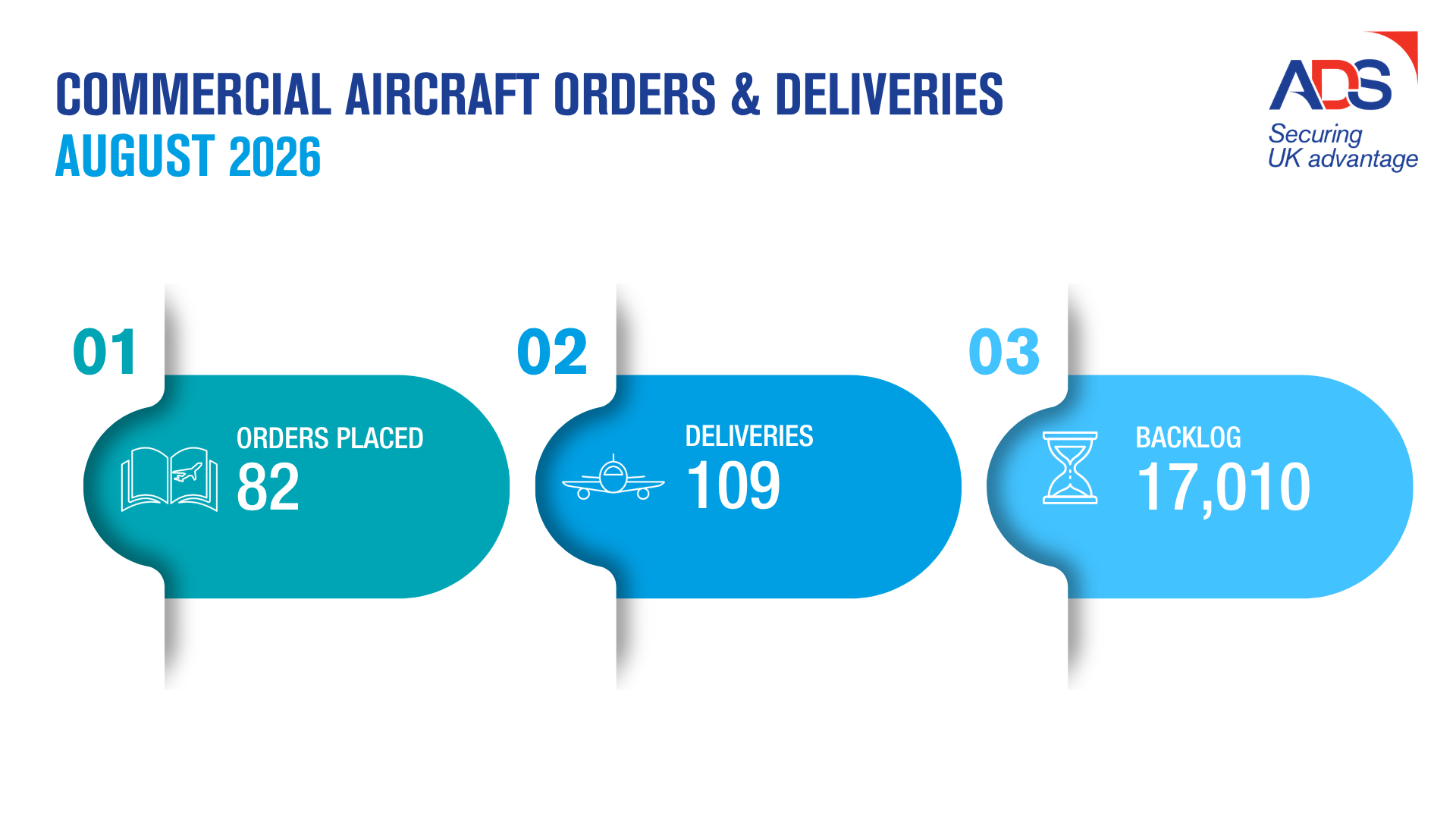
The industry body also found that a total of 109 aircraft were delivered during August 2026, down 8% on the same month last year. Despite this, August 2026 recorded the second-highest August delivery total of the past eight years, underlying signs of sustained industry momentum throughout the year.
ADS data also shows that 82 commercial aircraft orders were placed during August. While this represents a 34% decrease compared with August 2025, order activity remains robust, with 1,655 aircraft ordered so far this year, a 25% increase compared to the first eight months of 2025.
The aircraft backlog now stands at 17,010 orders, equivalent to over 12 years’ worth of work for the UK’s aerospace supply chain, and up to £391 billion in value to the UK economy at current production rates.
ADS outlook for 2026
With aircraft manufacturers focussed on ramping up production, ADS has developed three growth scenarios for how many individual aircraft will be delivered globally by year-end.
- Modest Growth Scenario: 1,490 aircraft delivered, up 6% on 2025.
- Medium Growth Scenario: 1,560 aircraft delivered, representing just over 10% growth.
- High Growth Scenario: 1,630 aircraft delivered, approximately 16% higher than 2025.
ADS analysis finds that an average of 147 aircraft deliveries need to be made every month for the next four months to reach the industry body’s ‘High Growth Scenario’ total of 1,630 aircraft.
Aircraft demand is heavily skewed toward narrowbody models, commanding roughly 80% of total demand due to booming domestic markets and a shift toward point-to-point regional routes. Widebody aircraft account for the remaining 20% of the market, supported by international fleet replacement cycles and freight demand, presenting the UK supply chain with a dual manufacturing challenge across both segments.
For the UK supply chain, this demand split creates a distinct operational balance: narrowbody programs drive high-volume component production and rapid factory ramp-ups, while widebody programs deliver lower-volume but incredibly high-value revenues through complex systems integration, advanced carbon-composite wing fabrication, and complete engine assembly across major industrial clusters in Broughton, Derby, and Bristol.
Aimie Stone, Chief Economist at ADS comments:
“Stability in production levels are welcome, but it is too soon to assume we are on a totally positive footing for the year’s end.
“Manufacturers are still facing supply chain and industrial challenges, but the strongest year-to-date delivery performance since 2018 shows the sector is moving in the right direction. The focus now must be on maintaining that momentum by addressing workforce shortages and unnecessary regulatory barriers that continue to constrain our industry’s ability to grow.”