The UK Defence ESG Charter brings together organisations committed to improving environmental, social and governance (ESG) performance, helping to build a more sustainable, resilient and responsible sector for the future.
Through data and practical case studies, the latest annual report showcases the progress made by Charter signatories. In these examples, we highlight how Leonardo, Level Peaks and Southbourne Rubber are reducing waste, recovering valuable materials and adopting circular economy principles to strengthen supply chain resilience and secure access to critical resources for the future.
CASE STUDY: LEONARDO
SHOWCASING WASTE REDUCTION STRATEGIES
A collaboration between cleantech start-up Uplift360 and Leonardo, has successfully transformed an end-of-life helicopter rotor blade into a prototype drone arm, marking a significant advance in critical materials recovery for aerospace and defence. Using its proprietary low-temperature chemical recycling process, ChemR, Uplift360 extracted high-quality, reusable carbon fibre from a rotor blade taken from a EH101, the forerunner of the AW101.
Once destined for incineration or landfill, the reclaimed fibres were repurposed into a structural component, proving the performance and potential of chemically recycled aerospace-grade composites. The project began under an R&D contract with Leonardo in May 2025 and focused on testing ChemR’s ability to process complex composite waste. Uplift360 exceeded the brief — not only recovering the material but also validating its use in manufacturing, showing how end-of-life components can re-enter the value chain.
This collaboration directly supports the UK’s Strategic Defence Review focus on strengthening supply chain resilience. Carbon fibre is critical to aerospace and military systems, yet the UK lacks sufficient recovery infrastructure. ChemR helps close that gap turning waste into a secure, domestic resource.
CASE STUDY: LEVEL PEAKS ASSOCIATES
CLOSING THE LOOP ON CRITICAL MINERALS
Securing the supply chain for modern tactical equipment demands a responsible approach to the entire product lifecycle. Level Peaks Associates is addressing this challenge through its ‘Through Life Management’ scheme, which supports the objectives of the UK Government’s Critical Minerals Strategy to create a circular economy and lower the impact of external shocks by increasing recovery and reuse rates for critical minerals.
The advanced systems Level Peaks supplies, from UAVs to thermal sights and soldier-worn power, are reliant on essential minerals like Lithium for high-density batteries, Germanium for thermal lenses, and rare earth elements for the permanent magnets in drone motors. By actively managing the return of used goods, Level Peaks ensures that these complex assets to national resilience are not simply discarded. Instead, they are assessed for repurposing or specialist recycling, allowing valuable high-grade materials to be recovered rather than lost to landfill. It acts as a practical demonstration of how SMEs can drive sustainability, ensuring that the defence equipment of today helps secure the resources needed for tomorrow.
SOUTHBOURNE RUBBER (SBR)
REDUCING MANUFACTURING WASTE
Southbourne Rubber (SBR) is tackling the industry-wide challenge of manufacturing waste by shifting the focus to adopting a preventative approach where material efficiency is maximised from the get-go.
It starts right on the production line, where SBR has tightened up moulding parameters and invested in sharper tooling. By refining these processes and bringing in automation, the SME has not only been able to drastically reduce the scrap and defective product output that would otherwise end up on landfills but also minimise the generation of hazardous waste from cured elastomer compounds.
Where hazardous waste is unavoidable, SBR applies strict handling procedures and dedicated and monitored waste streams to ensure safety and full traceability through licensed contractors. For non-hazardous materials, SBR has expanded resource recovery initiatives by separating recyclables at the source and introducing reusable packing.
Performance is continuously monitored through data-driven measurement, enabling the company to track waste trends, assess the effectiveness of initiatives and identify new opportunities for improvement. Together, these actions demonstrate how SBR’s practical and disciplined approach supports the goals of the UK Defence ESG Charter to contribute to a more sustainable, efficient and resilient defence manufacturing sector.
About the UK Defence ESG Charter
The UK Defence ESG Charter is a collaborative effort by the UK’s defence sector that aims to drive ambition and action on sustainability. Promoting greater transparency, signatories to the Charter are dedicated to working together to meet commitments focused on climate transition and clean tech, societal impact and governance and ethics.
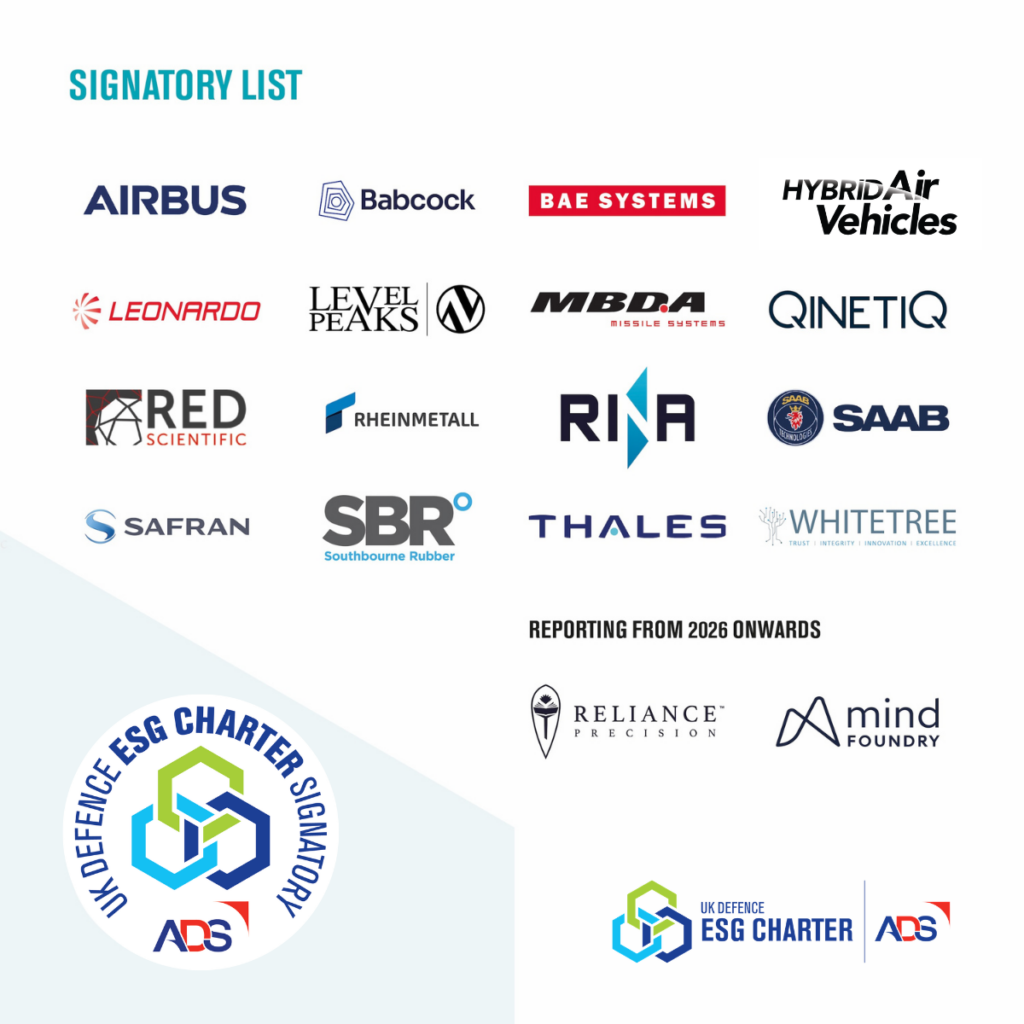
The UK Defence ESG Charter now has 18 signatories, from an initial seven inaugural companies. Each has supported ADS through data and case studies in the composition of our annual reports. The Charter itself was also shortlisted for the 2025 Trade Association Forum Awards in the category: Environment, Social & Governance Initiative of the Year.
Contact us on esg@adsgroup.org.uk for more information and to get involved.