
This summer we’re swapping laptops for lycra, and embarking on a 350-mile journey from Belfast to Bristol, taking in some stunning scenery along the way. Why not join us?
It’s all to support local communities through our three charity partners:
These charities are raising funds and awareness to support life-saving services, improve wellbeing and create opportunities for people facing significant challenges.
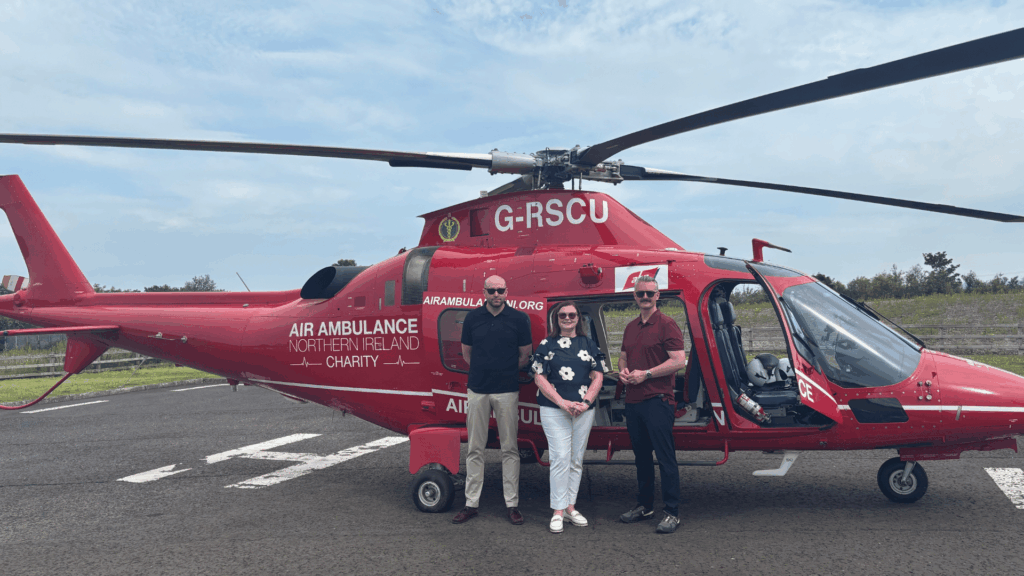
As part of our ‘Charity Conversation’ series, ADS’s Adam Doyle and Kevin Brien spoke to Briege Mulholland at Air Ambulance Northern Ireland to learn more about them and their key priorities, and how our donations can help them.
Tell us about Air Ambulance Northern Ireland
The charity Air Ambulance Northern Ireland, in partnership with the Northern Ireland Ambulance Service, provides the Helicopter Emergency Medical Service (HEMS) for Northern Ireland. This service brings the most advanced level of pre-hospital care to the most seriously ill and injured people in Northern Ireland. The helicopter can get to anywhere in Northern Ireland in approximately twenty-five minutes.
Air Ambulance NI saves lives, brains and limbs through…
- The Medical Team
The HEMS medical team always has an experienced paramedic and a consultant doctor on board. At scene the team can provide interventions including giving blood, inducing a coma, and surgical procedures that can be the difference between life and death. These interventions are usually provided once the patient reaches hospital.
- Air Ambulance Taskings
Bringing the hospital direct to the patient, every day the team respond to an average of two serious call outs, averaging 60 tasks per month. This could be in response to a workplace accident, road traffic collision, farming accident, or sports injury. You never know when you might need it, and it could provide a lifeline for one of your employees, or indeed one of your loved ones. We operate 365 days per year, between 7am and 7pm. As well as responding by helicopter, when the weather is too poor to fly, we respond by Rapid Response Vehicle, the calls signs are HM23 for the helicopter and Delta7 for the car.
How did it get started?
The Air Ambulance has been operating since July 2017, when we had our first tasking on 22nd July 2017 to Conor McMullan – read more about Conor McMullan’s Story.
Our focus remains the same. To provide pre-hospial emergency care to those in need, we bring the hospital to the scene.
What are the biggest challenges your organisation faces right now?
At the moment the biggest challenge is dealing with the rising cost of fuel, planning and securing a long term permanent base. The fuel is an immediate challenge, the permanent base is a project we have been working on and working towards for some time.
What’s your vision for the future, and how are you working towards it?
Our vision is firstly to provide pre-hospital emergency care; as part of that we are investing in a new helicopter which the charity will own directly; this will bring cost efficiency in the long term but ensure we are able to grow and develop if there is an requirement.
What could support from our members help you achieve, that wouldn’t otherwise be possible?
Supporting the charity with raising awareness, funds and publicity. Despite being operating for nine years, there is still a public perception that the charity receives government support which is doesn’t. We would love if via this campaign, we could increase our regular donors as part of our ClubAANI campaign. These monthly membership subscriptions really are a lifeline.
Air Ambulance NI needs to raise approximately £3m per year to keep the service sustainable. Over and above recurrent helicopter and maintenance costs, every tasking means additional fuel and pilot flying hour costs.
Learn more about Air Ambulance Northern Ireland here.
Rebekah Jones’ Story
 Rebekah Jones was on her way to work when she was involved in an RTC just outside Saintfield. Normally Rebekah travelled in with colleagues but as she was the only one coming from the Ballymena area, she was by herself in the car which collided with a lorry. A member of the public travelling behind Rebekah stopped the car and called 999. When the Air Ambulance arrived, the HEMS paramedic and HEMS doctor gave Rebekah pain relief due to the intense pain she was in and prepared her for transport to the Royal Victoria Hospital, where she remained for two weeks. Along with the open fracture in her leg, Rebekah also had spinal injuries, a fractured cheekbone, serious concussion and her kneecap had been shattered. The injuries to her kneecap were so extensive that it had to be removed. Rebekah has undergone intense physiotherapy, something she knew would be vitally important for her discharge from hospital and recovery. She said, “I genuinely owe the HEMS team my life.”
Read other lifesaving stories here.