
It hardly takes two glances at today’s newspaper headlines to see that that defence is vital to our national security, but also central to the UK economy. However, measuring the UK defence industry has long been a challenge. Official statistics primarily reflect Ministry of Defence (MOD) spend, with supplementary data on defence exports, but this approach struggles to capture the sector’s full breadth. Defence is highly regulated, increasingly intertwined with civil markets, and reliant on many suppliers that are not even aware of their inclusion in UK defence supply chains.
To address this gap, ADS and The Data City have developed a new Defence Real-Time Industrial Classification, or Defence RTIC. Rather than starting with how firms describe themselves, the Defence RTIC takes an activity-led approach, helping users identify what companies actually do and how those activities relate to defence capabilities.
From concept to definition: building the Defence RTIC.
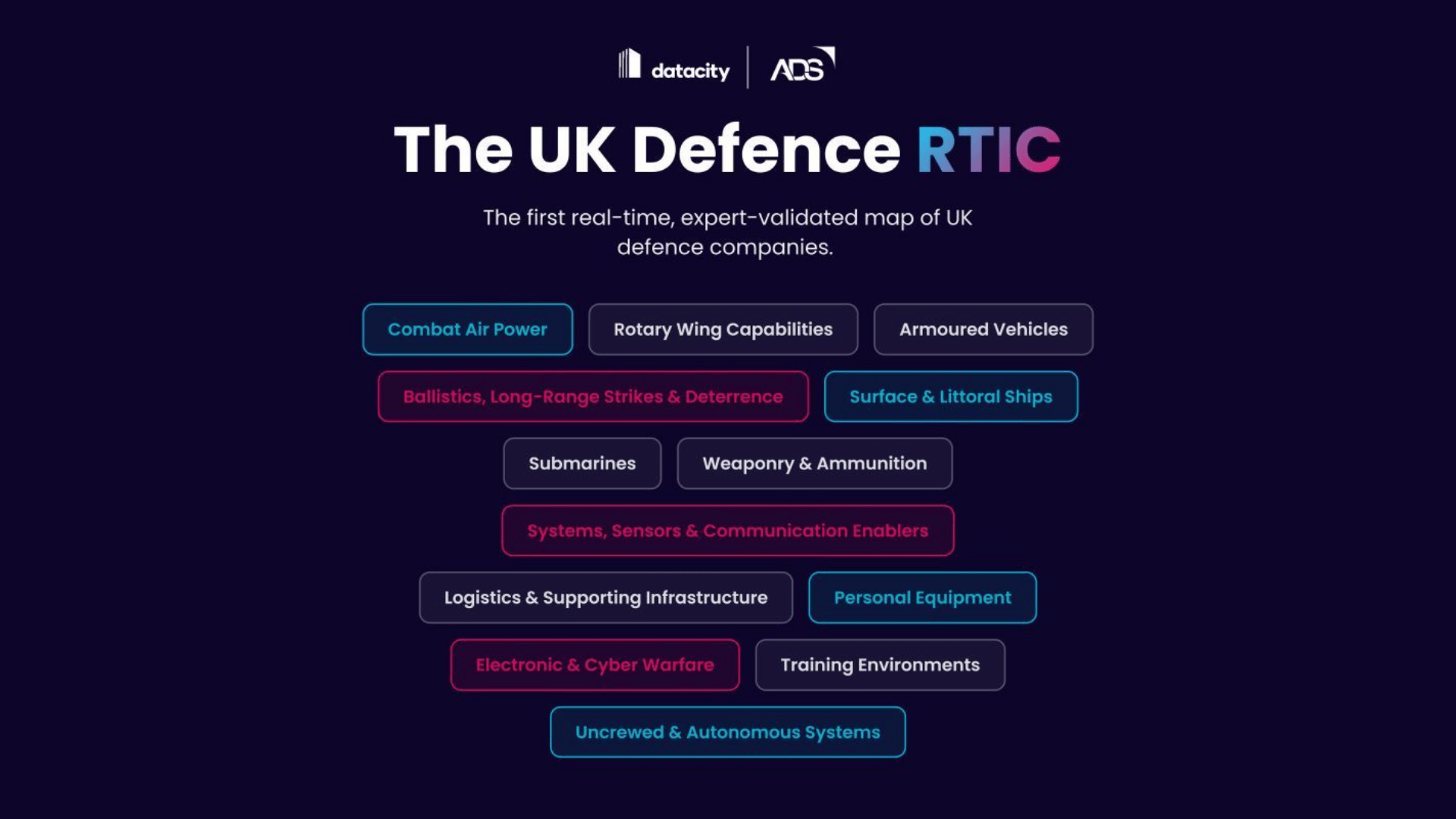
The starting point for the new Defence RTIC was a deliberate shift in perspective. Rather than asking whether firms classify themselves as defence companies, ADS and The Data City focus on the activities firms are undertaking. Drawing on ADS experts, trusted partners, and The Data City’s machine learning classification technology, defence activity is grouped into 13 capabilities or ‘verticals’. This reflects defence as a cross-industry ecosystem rather than as a siloed industrial category.
What the Defence RTIC captures
As of April 2026, the Defence RTIC includes over 2,100 companies with each assigned to at least one of the 13 defence-relevant verticals. The RTIC reveals important structural features of defence activity:
- 1,781 companies (84%) have at least one manufacturing capability
- 573 companies (27%) also sit within the Advanced Manufacturing RTIC
- 248 companies (12%) are captured within the Space Economy RTIC
- At least £7.1bn of total investment funding has been raised by companies listed in the RTIC, based on the data from The Data City’s partner Dealroom
- Approximately £2.1bn of Innovate UK grant funding has been secured across 397 individual grants by companies in this RTIC
- There are 1,178 women directors identified across the defence RTIC meaning around 20% of companies in the RTIC are women-led
How the Defence RTIC sits alongside ADS Defence Outlook data
With the Defence RTIC and ADS Defence Outlook designed to be used together, each provides a different but complementary perspective on the UK defence sector. The ADS Defence Outlook offers long-standing estimates of the entire sector’s economic contribution, for instance reporting that defence generated £15bn in value added to the UK economy in 2024 and supported 181,500 direct jobs.
The Defence RTIC adds an activity-led layer to the picture. Rather than measuring scale, it sheds light on how defence activity is structured across firms, the mix of capabilities involved, patterns of firm behaviour, and overlaps with adjacent sectors.
By combining the long-standing authority of the ADS’ Defence Outlook with activity-led tools like the Defence RTIC, it becomes easier to answer not just how large the sector is, but how it is structured, how it is evolving and where its future capabilities may emerge.
Watch the Defence RTIC Webinar
On 14 May 2026, ADS and The Data City hosted a joint webinar to introduce the Defence RTIC and explore its role in improving the evidence base for the UK defence sector. As part of the session, ADS Chief Economist Aimie Stone provided an update on the policy and macroeconomic context shaping the defence sector, highlighting the growing need for better evidence to inform decision making. Alongside this, Paul Swinney, Chief Economist at The Data City, showcased the data platform and demonstrated how the Defence RTIC can be applied across a range of use cases, including mapping company activity, investment patterns, and geographic distribution across the defence landscape.
You can now watch the full recording of the session here.
Developed in partnership with ADS, the Defence RTIC is now accessible via The Data City platform, providing a new way to examine the structure of the UK defence industrial base. Prospective customers will be subject to ADS vetting before access to the platform.