
Introduction
The publication of the Spending Review, the Industrial Strategy and the Trade Strategy in June 2025 brought a range of financial measures aimed at supporting UK firms. To help clarify the opportunities to members, ADS has produced an update on the UK’s three key public financing institutions: the British Business Bank (BBB), the National Wealth Fund (NWF) and UK Export Finance (UKEF).
British Business Bank (BBB)
At a glance:
The BBB, established in 2014 and headquartered in Sheffield, is the UK’s state-owned economic development bank with £25.6 billion of financial capacity. It is structured as a public limited company and wholly owned by the Department for Business and Trade (DBT), although it is operationally independent.
The BBB’s stated goal is to increase the supply of credit to small and medium-sized enterprises (SMEs), focusing support to stages between seed and series C funding. It works with a network of 200 private credit insurers and lenders, rather than directly with SMEs, to help UK companies access finance in the form of loans, equity investments, and guarantees.
What’s new:
Investments on high-growth sectors
The Spending Review increased the Bank’s total financial capacity from £17.4 billion in 2024 to £25.6 billion during this Parliament, enabling investments to around £2.5 billion a year. Of new capital invested through the BBB, £4 billion will directly target the 8 high-growth sectors identified in the Industrial Strategy (IS-8) as part of the new Strategy Growth Capital initiative. For instance, the new UK Sovereign AI Unit, part of the AI Action Plan, will benefit from up to £500 million through the BBB. The National Security Strategic Investment Fund (NSSIF), part of the BBB, will increase its investments from £20m to £100m.
Regional investments
Following the Industrial Strategy, the BBB will introduce a new Cluster Champions Programme supporting 10 city regions: Greater Manchester, West Yorkshire, the West Midlands, Liverpool City Region, South Yorkshire, North East, West of England, Glasgow City Region, Cardiff City Region, and Belfast City Region through a £100 million expansion of the BBB’s Nations and Regions Investment Funds (NRIF). £350 million for NRIF will strengthen innovation in the Southeast and East of England.
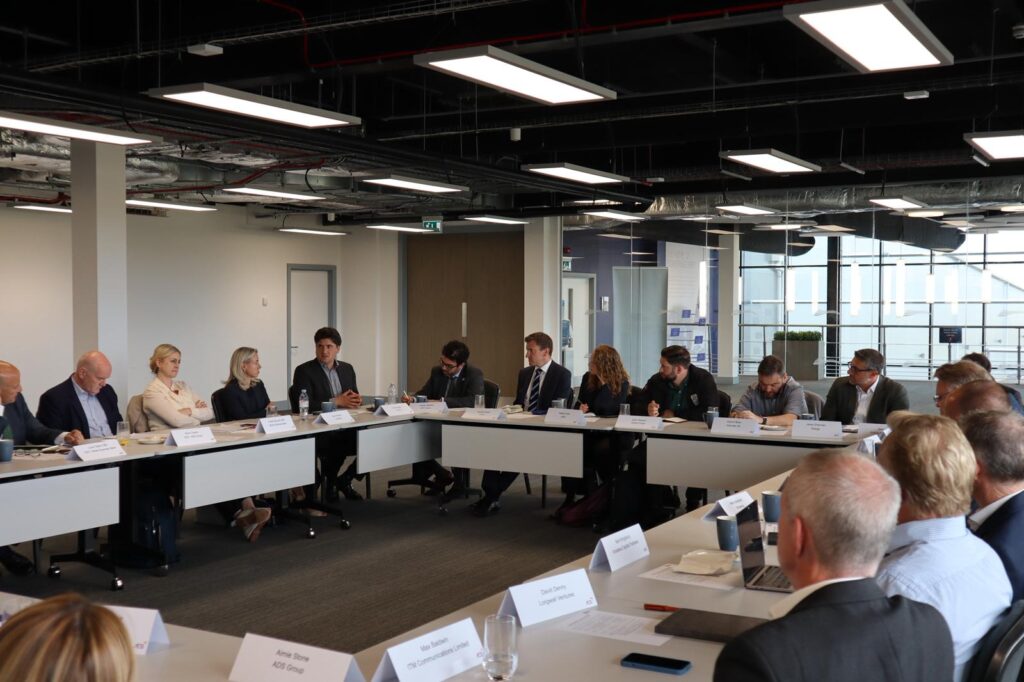

BBB by ADS Defence Roundtable: July 2025
Key products:
The BBB offers smaller loans (generally between £25,000 – £100,000), debt finance (£100,000 – £5m) and equity finance (up to £5 million) through its regional investment funds: Wales, Scotland, Northern Ireland, the ‘Northern Powerhouse’, the ‘Midlands Engine’, and the South West regions of England. Enquiries and applications are made directly to regional fund managers. Other products of interest include nation-wide programmes, such as Angel CoFund for equity funding, and start-up loans for new businesses, which include free mentoring and business courses. Lastly, the Growth Guarantee Scheme set in summer 2024 recently received £500 million of extra funding aimed at smaller businesses that may need cashflow support because of changes in global tariff rates.
National Wealth Fund (NWF)
At a glance:
The NWF is the 2024 Labour Government’s successor of the UK Infrastructure Bank (UKIB) set up in 2021. It is headquartered in Leeds and wholly owned by, but operationally independent of, HM Treasury. The NWF is a strategic sovereign wealth fund focused on national development goals – unlike other sovereign funds that invest in real and financial assets globally to maximise long-term return – with a capitalisation of almost £28 billion.
The NWF plugs gaps where there is an undersupply of conventional finance by investing alongside the private sector. The NWF has a target mobilisation ration of 1:3, meaning it aims to ‘crowd in’ £3 of private capital for every £1 invested.
What’s new:
The NWF’s primary mandate was the clean energy, digital and tech, advanced manufacturing, and transport sectors. HMG strategies are expanding this remit, and the NWF now considers investments in dual-use technologies and supply chain resilience in strategic areas.
Key products:
The NWF focuses on capital-intensive projects with a minimum ticket size of £25 million for private investments. In practice, this means that its equity investment targets higher technology readiness levels (TRLs 7-9). Interested businesses are invited to contact them to make an enquiry.
UK Export Finance (UKEF)
At a glance:
A long-standing government department independent of, but working with Department for Business and Trade (DBT), UKEF is the UK’s export credit agency with £80 billion of financial capacity this Parliament. UKEF partners with 100 private lenders and insurance brokers to support exporters through capital loans, export insurance, and guarantees to international buyers.
What’s new:
The Industrial and Trade Strategies have substantially enhanced UKEF’s capabilities. HMG expanded UKEF’s total capacity by £20 billion to £80 billion, of which £13 billion is allocated for direct lending to boost British exports across the IS-8, including £3 billion for defence exports. Other announcements include the Small Export Builder, which will provide enhanced export insurance accessibility, and the Repeat Order Guarantee to streamline support for ongoing international buyer relationships.
Key products:
UKEF offers a range of products and services to both SMEs and larger businesses, including guarantees, financing and insurance. Applications to the appropriate product is made through the relevant contact form.
ADS Commentary
The BBB, NWF, and UKEF have complementary mandates, which means that their products intervene at different stages of businesses’ development. In practice, businesses concerned with early-stage development will look at BBB products, while UKEF can help with scale-up through export support and the NWF focuses on major projects.
The BBB and NWF have established referral links, when the NWF and UKEF maintain a more operational relationship. All three will now collaborate more closely to deliver the government’s strategies, sitting together (alongside UK Research & Innovation and Great British Energy) at the new Strategic Public Investment Forum and at the Industrial Strategy Council jointly headed by the DBT and HMT.
ADS is actively engaging with all three bodies to explore how additional capital, and the expansion of their mandates could benefit our sectors. On 23 July, ADS CEO Kevin Craven and BBB CEO Louis Taylor co-hosted a roundtable focused on defence financing. The session brought together industry and investors to discuss key challenges and potential solutions. Unsurprisingly, the need for clearer demand signals from the government and faster decision-making processes emerged as central themes. Suggestions to the BBB for supporting scale-up funding included greater use of guarantees and implementing a soft loan system to help SMEs remain operational while awaiting contract confirmation.
Engagement between industry and finance bodies is crucial to improving information sharing between investors and businesses. With a target of attracting £12 billion in private investment, the BBB has a crucial role to play. Beyond this, it aims to drive broader political shifts in the narrative surrounding defence financing. Building on the momentum from this engagement and anticipating the BBB’s update on its five-year plan this autumn, ADS is already planning several follow-up sessions that will tie-in our four sectors.