

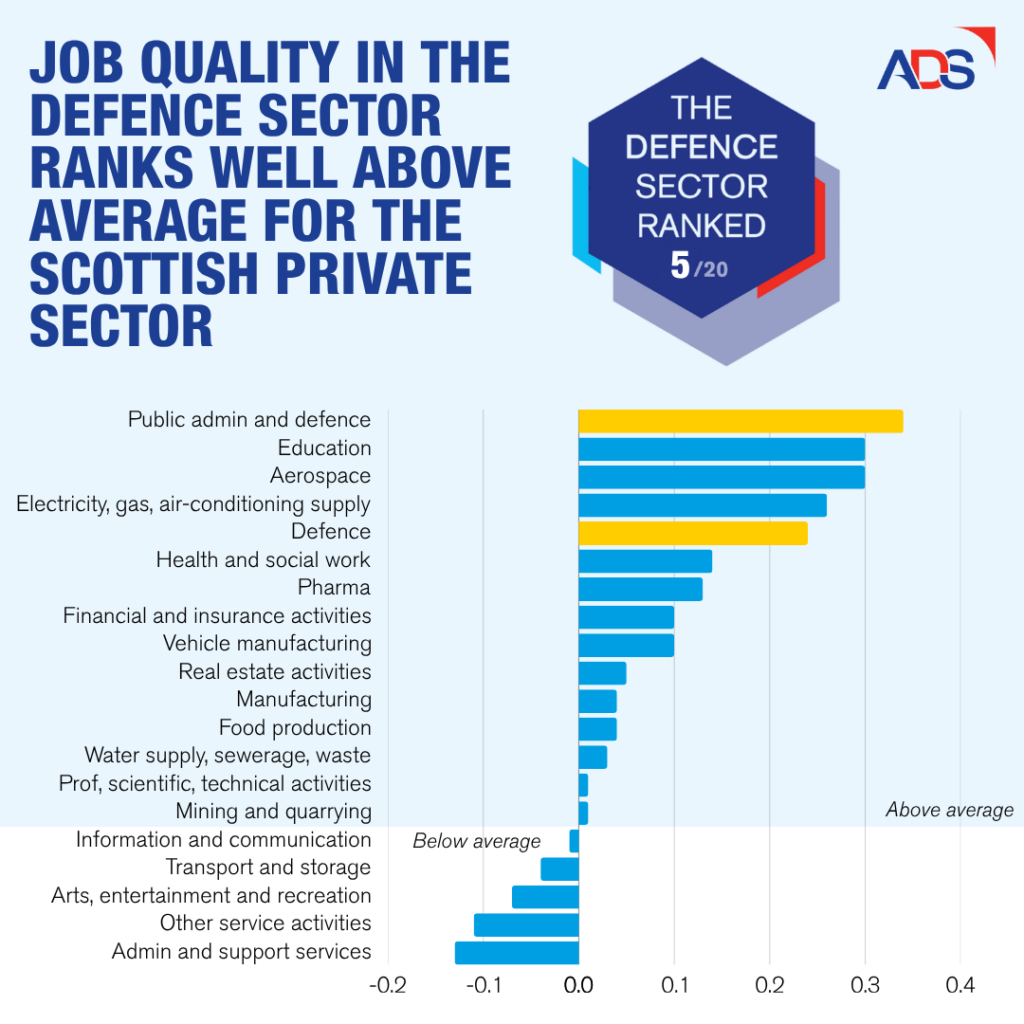

The ADS Quality Jobs Index is the UK’s first national league table of job quality, comparing roles across the economy on a like-for-like basis. It provides a consistent, comparable way to understand whether jobs are secure, well-paid, sustainable, and offer long-term prospects to people.  

Jobs are assessed across six recognised dimensions of ‘good work’:

  • Pay and pensions
  • Training and career development
  • Work–life balance
  • Stability and contractual terms
  • Health and wellbeing
  • Worker voice

Each job receives a score relative to the UK average (set at zero). Jobs above zero are classed as above average quality.

The Index shows that job quality in the defence sector in Scotland is well above the average for private sector jobs. A clear majority of defence roles score above the national benchmark, reflecting strong pay, job security and long term career prospects.

Based on ADS economic analysis used alongside the Index:

  • Around 16,000 people are employed in the defence industry in Scotland (2024)
  • Defence contributes ~£1.3 billion in GVA to the Scottish economy
  • Defence productivity in Scotland is around £80,000 per worker, higher than the UK average

View source here.

These roles are concentrated in engineering, advanced manufacturing, naval, aerospace and complex systems work – sectors that tend to score highly on job quality measures.

Scotland is consistently identified as one of the stronger UK regions for quality defence employment, alongside the North West of England and Northern Ireland. 

The Index highlights that defence jobs in Scotland are not only significant in number, but disproportionately high quality compared with many other industries operating in the same local labour markets.

Future Impact Scenarios

Alongside the Index, ADS published separate economic modelling exploring what could happen if UK defence spending rises to around 3–3.5% of GDP by the mid 2030s.

Under a 3% spending scenario, ADS analysis indicates that by 2035 Scotland could see:

  • Defence employment grow to almost 19,000 jobs, an increase of around 46%
  • Nearly 6,000 additional full time equivalent roles
  • Defence GVA rising to around £1.7 billion

Under a 3.5% spending scenario:

  • Scotland could see around 8,000 additional defence jobs
  • Scotland experiences one of the largest percentage increases in defence employment of any UK nation (second only to Northern Ireland)
  • A significant share of new roles are expected to meet the “high quality job” threshold used in the Index

Why this matters for Scotland:

  • Scotland already hosts a high skill, high productivity defence workforce
  • Defence jobs tend to be long term and geographically anchored, supporting communities well beyond the Central Belt
  • The Index provides evidence that defence aligns with Scottish priorities around fair work, skills, productivity and regional economic resilience

A Manifesto for Scotland

ADS Priorities for the 2026 Scottish Election

For too long, the aerospace, defence, security and space sectors have been under supported, underappreciated and overly stigmatised. With the appropriate support, Scotland is uniquely positioned to become a global leader in defence and advanced manufacturing. That is why ADS wants to see the next Scottish Government play to Scotland’s existing strengths.

Find out more

  1. Index dependent on the availability of variables within large datasets (to allow for sectoral, occupational and geographic analysis). This limits the choice of indicators.
  2. Draws on three datasets: Labour Force Survey, Wealth & Assets Survey, Understanding Society. A smaller set of indicators are used to calculate the number of ‘high quality’ jobs (LFS data only).
  3. Each sub-index consists of a range of equally weighted data points, except ‘reward’ where salary indicators are weighted 80% and pension indicators 20%.
  4. Individual indicators are standardised using z-scores to ensure they have a proportionate effect on their sub-index. The six sub-indices are equally weighted in the overall index.

For more information, please contact economics@adsgroup.org.uk.