
The UK Defence ESG Charter brings together organisations committed to improving environmental, social and governance (ESG) performance, helping to build a more sustainable, resilient and responsible sector for the future.
The latest annual report highlights the progress made by Charter signatories including case studies from Airbus Defence and Space, Hybrid Air Vehicles and MBDA UK, who are contributing to clean and innovative technologies.
AIRBUS DEFENCE & SPACE
TRACE
As part of Airbus’ ambition to address the climate impact of our products and the wider aerospace industry, the company is deeply and transnationally engaged in research aimed at reducing the uncertainty in the current understanding of the impact of non-CO2 emissions on the climate. The TRACE project (Technologies to Reduce and Assess Contrail Effects) harnesses the UK-based expertise and technical skills needed to build upon this research.
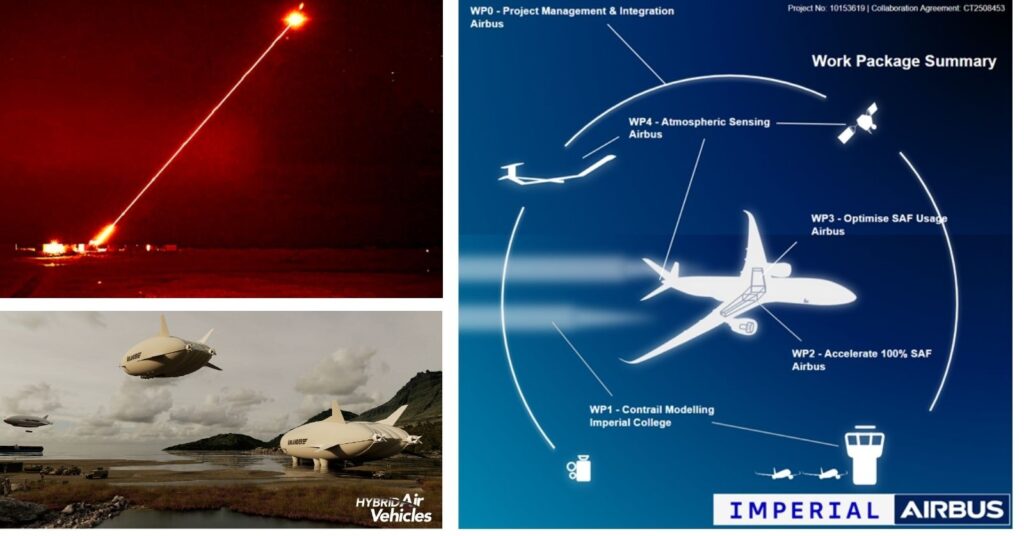
A multi-partner research project co-funded by Innovate UK, TRACE draws together experts from Airbus Commercial Aircraft, Airbus Defence and Space and Imperial College London, and comprises four main work packages that span from data analysis to fuel specification to technology development. One key work package, led by Imperial College, seeks to deliver improved representation of the impact of air traffic on contrail formation using open-source academic publications and models on contrail microphysics, wake vortex and overlapping trails. Better, smarter models and understanding of contrail formation and behaviour will help to inform aircraft avoidance and mitigation strategies and technology.
Some of the more product-orientated work within TRACE is led by Airbus Defence and Space and will support the development of on-aircraft humidity sensors to enable in-flight detection of ice-saturated regions of the atmosphere where persistent contrails are most likely to occur. This capability has a dual-use potential of helping aircraft avoid both the creation of a warming contrail and a flight path which could be detected by unfriendly forces.
Non-CO2 emissions is a problem that cannot be solved by one player alone. It requires an unprecedented level of industry collaboration and adoption of solutions. Airbus is proud to leverage the best of the UK to reduce uncertainty around the climate impact of non-CO2 emissions for the benefit of Airbus and the entire industry.
HYBRID AIR VEHICLES
PIONEERING NET ZERO CAPABILITIES WITH AIRLANDER
Decarbonising is a critical strategic challenge in both civil and military aviation, requiring solutions that align with the UK’s Net Zero trajectory without compromising on operational advantages. Hybrid Air Vehicles is answering this call with Airlander 10, a highly innovative aircraft with the potential to decouple defence capability from greenhouse gas emissions. Utilising a combination of buoyant lift from helium and aerodynamic lift, Airlander will deliver up to a 90% reduction in emissions relative to comparable aircraft once type certified, with a robust pathway to offer an all-electric configuration by 2030. Beyond its net zero credentials, Airlander excels in the defence landscape due to the unique combination of high payload and long endurance, providing a force-multiplier effect. It is resilient, scalable and ultra-cost effective (up to 10x less cost per flying hour), operating with minimal ground infrastructure and deployable without host nation support for up to 30 days. Airlander’s cabin is completely configurable by the customer, so can facilitate many military applications from ISR to the movement of people and goods.
Crucially, this is a story of industrial implementation, not just R&D. As the only company in the world to have flown a full-scale prototype hybrid aircraft, Hybrid Air Vehicles is working with South Yorkshire to bring 1,200 high-skilled green jobs to their aerospace cluster. With the aircraft approaching entry into service, it stands as a powerful testament to the UK defence sector’s ability to drive green growth, proving that sustainability and operational resilience can go hand in hand.
MBDA UK
DRAGONFIRE HIGH ENERGY LASER SYSTEMS
DragonFire is a laser directed energy weapon (LDEW) demonstrator. DragonFire can deliver a high-power laser over significant ranges in varied weather conditions, with pinpoint accuracy for tracking and pointing.
LDEW systems are of significant interest to defence because they are expected to provide military useful effect at reduced costs when compared to other weapon systems.
Having demonstrated that the technology is credible, there is a defence push to solve system integration challenges and place the capability in the hands of the user. LDEW systems emit precisely targeted light; this means that there is less likelihood of collateral damage, and no possibility of unexploded ordnance (except if an enemy weapon is targeted).
LDEW can complement conventional defensive capabilities but can reduce the need for forces to use alternative forms of ammunition, providing an option which can respond to mass requirements and ensure in-theatre resource efficiency. Depending on the power of the system, LDEW are expected to be effective against a wide range of threats from unmanned aerial vehicles (UAV) to anti-ship missiles.
Whilst the power used by the systems is not insignificant, it could in theory be generated by sustainable means. The logistic chain for LDEW is short compared with many weapon systems, meaning fewer emissions will be emitted because of transportation. Further trials will aim to reduce the system’s size, weight and power requirements, which will reduce pressures upon defence logistics operations and ensure fewer emissions as a result of DragonFire transport and use.
About the UK Defence ESG Charter
The UK Defence ESG Charter is a collaborative effort by the UK’s defence sector that aims to drive ambition and action on sustainability. Promoting greater transparency, signatories to the Charter are dedicated to working together to meet commitments focused on climate transition and clean tech, societal impact and governance and ethics.
The UK Defence ESG Charter now has 18 signatories, from an inital seven inaugural companies. Each has supported ADS through data and case studies in the composition of our annual reports. The Charter itself was also shortlisted for the 2025 Trade Association Forum Awards in the category: Environment, Social & Governance Initiative of the Year.
Contact us on esg@adsgroup.org.uk for more information and to get involved.