

In September 2026, the Government published the UK Space Strategy, setting out a vision for the UK to become a “competitive space power” and backing that ambition with more than £7.8 billion of funding through to 2030. The Strategy is the first major refresh of the UK’s space policy since the National Space Strategy was published in 2021 and reflects a significantly changed geopolitical, technological and economic environment. It places greater emphasis on defence, national security, industrial scale-up and economic growth, while signalling a more interventionist role for government in supporting the sector.
Colleagues from within the departments should be congratulated on the scope and ambition of the Strategy, including the achievement in gaining consensus from several Secretaries of State before publication. It represents real progress from the National Space Strategy in terms bringing civil and defence, designer and user, closer together, and recognises that the UK can achieve its growth and national security ambitions through international partnerships. There perhaps remains some progress to be made on defining the aimed for “end state” post-implementation of the strategy, but the Technical Delivery Annex is a very welcome inclusion.
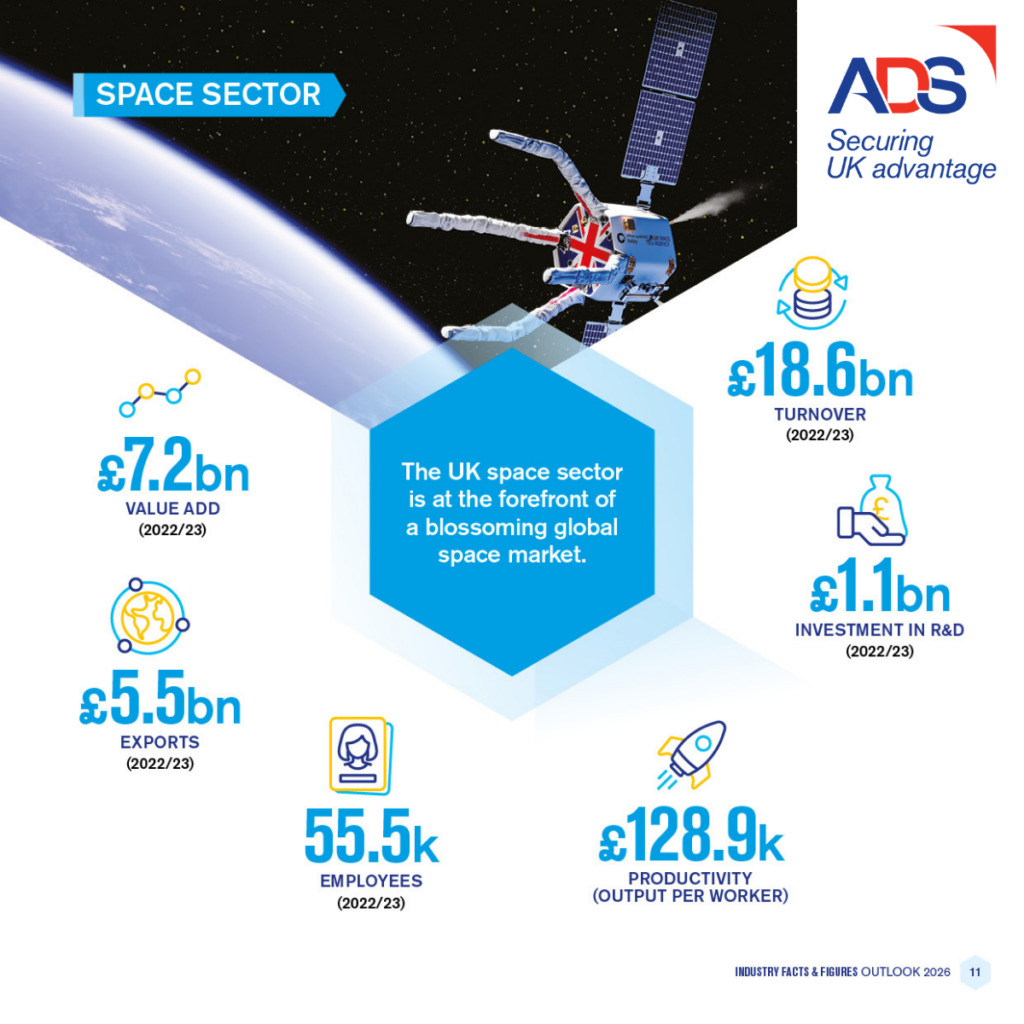
The Strategy is clear in its acknowledgement that space is critical national infrastructure, underpinning the UK’s economy, security and long-term prosperity. The sector underpins modern life, from financial transactions and communications to weather forecasting, defence and national security. As the Government notes, satellites support around 18% of UK GDP, while the space sector contributes more than £7 billion in gross value added to the economy and supports over 55,000 jobs across the country in 2024, according to the UK Space Agency’s Size and Health of the UK Space Industry report.
What is particularly encouraging is the Strategy’s focus on industrialisation and scale. The Government is clear that too many UK space companies remain trapped between successful technology development and commercial growth. The Strategy identifies challenges around access to finance, high capital requirements and scaling businesses, and acknowledges that government has a more active role to play in helping companies bridge that gap. It is particularly welcome to see commitments to improve access to finance, support commercialisation and consider government’s role as an anchor customer through initiatives such as the Enterprise Space Category.
ADS has consistently argued that Government must play its role as an anchor customer, providing the long-term demand signals that give businesses and investors the confidence to invest and expand. The Strategy’s commitment to using procurement more strategically, supporting domestic supply chains and improving access to finance reflects many of the priorities industry has been calling for. The UK space sector is globally regarded as a strong sector with which to do business, one that proudly delivers high-value jobs and national economic prosperity.
The publication of the Strategy also comes at a moment of significant change for the sector. Following the creation of the new Department for Business, Innovation, Science and Trade (BIST), responsibility for the UK Space Agency will transfer into the department. While any machinery of government changes bring transitional challenges, there is a significant opportunity here. By placing space alongside industrial strategy, investment, exports, innovation and business growth, the new structure reinforces the case for viewing space as an advanced manufacturing sector, a strategic national capability and a driver of economic growth.
The Strategy also provides greater clarity on where the Government intends to concentrate effort, prioritising satellite communications, space domain awareness, in-orbit servicing, assembly and manufacturing, and assured access to space. While support for the wider ecosystem still remains important, a clearer sense of direction in some areas should help businesses and investors understand where government sees the greatest opportunities for growth and strategic advantage.
The validation in this approach will be in how this strategy is ultimately delivered. Space businesses make investment decisions over years and decades, not months. While the headline funding commitment is significant, industry will now be looking for greater clarity on programmes, procurement opportunities and implementation timelines. The Strategy includes welcome commitments around capabilities such as sovereign space domain awareness and nationally separable space capabilities, and businesses and investors alike will need confidence that strategic ambition will be matched by predictable demand and sustained delivery.
Overall, the UK Space Strategy is a welcome step forward. Its emphasis on growth, national security, commercialisation and industrial scale closely reflects many of the priorities ADS has been advocating for. The challenge now is turning that ambition into tangible programmes, contracts and opportunities for UK businesses. Under the One Government approach, referenced throughout the Strategy, the UK should adopt a robust future-oriented posture toward emerging capabilities, both to keep pace with global developments and, more ambitiously, to secure early-mover advantage and strengthen its global leadership.
ADS looks forward to working with Government and industry partners to help turn the Strategy’s ambitions into reality and ensure the UK remains one of the world’s most innovative, competitive and resilient space sectors. On behalf of our members, we will remain a key partner to Government, and as the international partner of choice in strengthening the UK’s competitive advantage in space.