
The UK Defence ESG Charter brings together organisations committed to improving environmental, social and governance (ESG) performance.
Charter signatories are investing in people, technology, and capability in a way that continues to provide exceptional value to the UK, both economically and socially. For example, on average, a staggering 39,263 training hours were delivered per Charter signatory in 2024 alone. To put that volume into perspective: this represents over 18 years of continuous work dedicated solely to keeping employees fully trained. They also employ 7,400 apprentices, representing a 14% increase from 2023 to 2024.
The latest annual report, provides ESG performance data, supported by case studies that demonstrate how Charter signatories are delivering the ambition of reinforcing the UK’s position as a global defence industrial leader by 2035.
Here are two initiatives showcased in the report…
CASE STUDY: THALES
BUILDING JOB-READY ENGINEERING SKILLS THROUGH AN ACADEMY MODEL
The UK defence and security sector has a need for more people with specialised engineering skills to ensure the longevity of its supply chain. Employers are facing difficulties in the recruitment of specialised skillsets which can result in a skills gap across the industry. This is why there is a need now more than ever to convert local talent into a workplace-ready capability, at pace. To tackle this challenge, Thales in the UK are paving the way with their Academy model which operates across the UK and globally, but the core of this activity all started in Belfast in 2023.
In Northern Ireland, the Academy links academic learning with on-the-job training. This helps to support recruitment and retention into high value roles including engineering. Since 2023, the Academy in Belfast has recruited 120 Future Talent roles consisting of graduates, apprentices and interns. The Academy works with both South Eastern Regional College (SERC) and University of Ulster (UU) to offer a range of professional qualifications from Level 2 to Level 7 apprenticeships with the aim to develop, upskill and grow the talent pipeline across the business, not just during the years of an Early Career cycle.
The Academy in Belfast has an extremely high retention and success rate with all 21 of the first cohort of Future Talent degree apprentices sitting on a 1st class honours through UU. With 51 members of senior staff currently working with the Academy and a 20% increase of female external hires, it’s clear that this model is working to help bridge the skills gap and create a more diverse and inclusive workplace. This model is part of Thales Group’s learning culture and global skills development programme and includes other academies across the UK in Glasgow and England to provide upskilling in sonar, electronic warfare and electro-optics, providing professional growth and maintaining Thales employees’ expertise at the highest level.
CASE STUDY: WHITETREE
STRUCTURED COMMUNITY CAPABILITY SUPPORT
As an SME operating within the UK aerospace and defence sector, Whitetree is committed to delivering responsible and measurable ESG impact.
Recognising that many Voluntary, Community and Social Enterprises (VCSEs) face barriers when accessing funding, particularly in bid development, outcome articulation and governance structuring, Whitetree operates a structured, application-based support initiative. Each year, a limited number of organisations are selected through a defined and transparent application process, with priority given to initiatives demonstrating clear community benefit and development potential. Selected organisations receive focused advisory sessions designed to strengthen funding and grant applications, improve impact measurement and performance articulation, enhance governance and programme structuring capability, and build internal confidence and repeatable skills.
The support is targeted and time-bound, ensuring meaningful capability uplift rather than dependency. By focusing on knowledge transfer and practical tools, participating organisations are better equipped to secure future funding and sustain their operations independently. Through this structured model, Whitetree contributes to greater organisational resilience within the third sector, stronger local delivery capability, improved access to funding for community-led initiatives and long-term skills development aligned with broader STEM and employability objectives.
This approach reflects Whitetree’s belief that effective ESG delivery combines measurable social value with commercial sustainability and governance discipline.
About the UK Defence ESG Charter
The UK Defence ESG Charter is a collaborative effort by the UK’s defence sector that aims to drive ambition and action on sustainability. Promoting greater transparency, signatories to the Charter are dedicated to working together to meet commitments focused on climate transition and clean tech, societal impact and governance and ethics.
The UK Defence ESG Charter now has 18 signatories, from an initial seven inaugural companies. Each has supported ADS through data and case studies in the composition of our annual reports. The Charter itself was also shortlisted for the 2025 Trade Association Forum Awards in the category: Environment, Social & Governance Initiative of the Year.
Contact us on esg@adsgroup.org.uk for more information and to get involved.
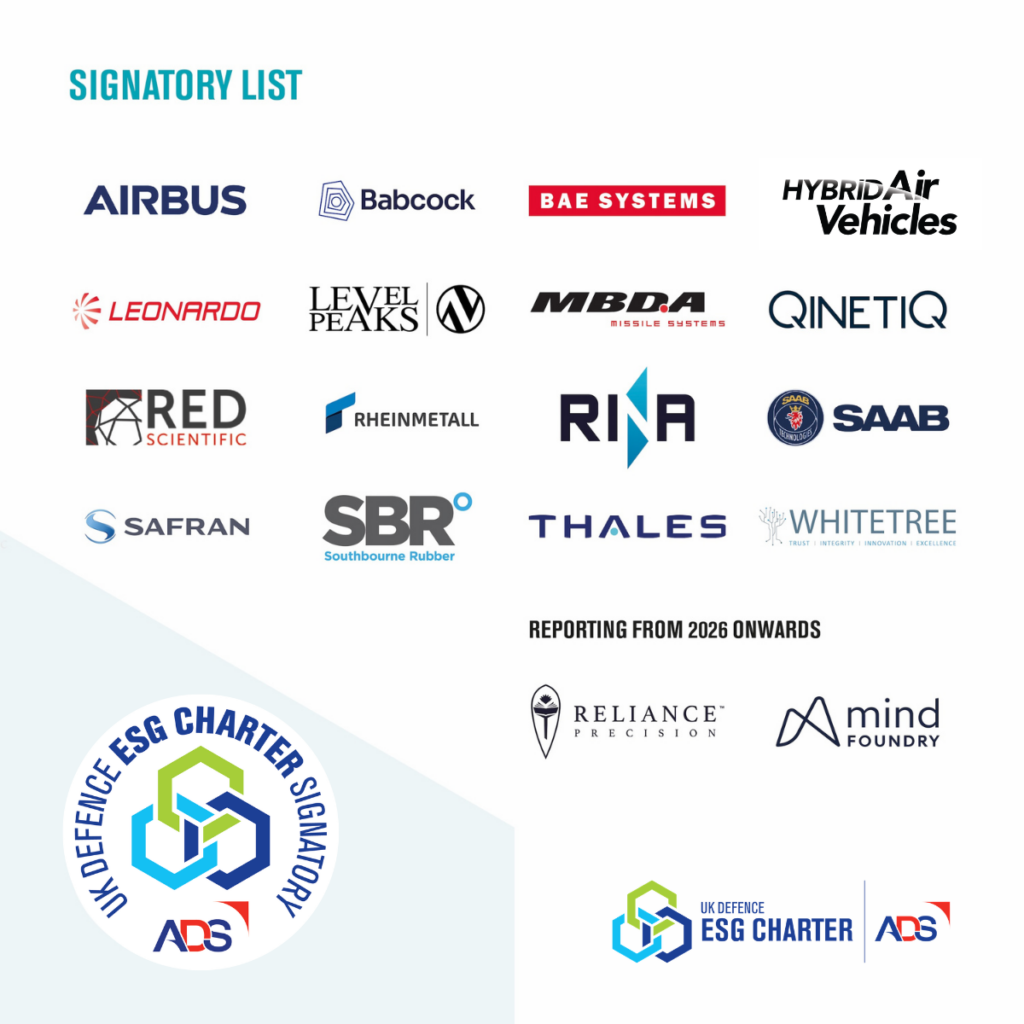
Image: UK MOD © Crown copyright 2026