
The UK Defence ESG Charter brings together defence companies committed to improving environmental, social and governance (ESG) performance, helping to build a more sustainable, resilient and responsible sector for the future. The latest Charter annual report highlights the progress made by Charter signatories.
In this blog, we review some of the themes coming out of the report to explore what the Charter tells us about resilience in practice.
ESG-enabled resilience
Debates about defence resilience often focus on supply chains, production capacity and stockpiles. Increasingly, however, they also encompass workforce capability, energy security and governance, all key ESG priorities. These themes sit at the heart of the 2026 Annual Report of the UK Defence ESG Charter (the “Charter”).
The report comes as the UK Government’s Defence Industrial Strategy (DIS) places renewed-emphasis on industrial capacity, readiness and the ability to operate under sustained pressure. The Charter’s latest data provides a useful snapshot of how defence companies are responding to many of these challenges.
Scale and substance
Now in its second year, the Charter has grown to include 18 signatories, representing more than 60% of UK defence industry turnover and over 55% of defence employment. That scale matters, but so does consistency. For the second year running, the Charter provides a comparable set of ESG indicators for both major defence businesses and SMEs, allowing progress over time and across the sector.




Renewable Energy is readiness
One great example to illustrate the Charter’s ability to showcase real-world change is energy security. In 2024 alone, Charter signatories delivered a 13% reduction in defence-generated Scope 1 and 2 emissions, while sourcing almost a quarter of their energy from renewables.
Signatories highlighted a range of measures, including electrification where feasible, on-site renewable generation, and improved energy monitoring. Alongside environmental objectives, these investments can help reduce exposure to energy price volatility and strengthen operational resilience. More than that, recent geopolitical turmoil has underlined the value of more diversified Critical National Infrastructure in supporting resilient supply chain and national security. A more geographically dispersed, and in some cases, more sovereign energy supply, can indeed strengthen the sector’s ability to operate through shock.
People underpin endurance
At the heart of the Charter, and the sector at large, are the people. In 2024, Charter signatories again showcased a sustained investment in skills, supporting 7,400 apprentices, up 14% year-on-year, while delivering an average of 39,000 staff training hours per company. These investments align closely with the DIS ambition to sustain the skills base needed to support future demand, technological change and industrial growth.
The Charter’s commitment to societal impact also places a key focus on strengthening meaningful partnerships with local communities across the UK, and improving diversity, equality, and inclusion at all levels. For instance, in 2024, women employed by signatories earned 92 pence for every pound earned by men, an improvement of one percentage point compared with the previous year. The proportion of employees under the age of 30 also increased.
As illustrated throughout the report’s signatory case studies, companies continue to place significant emphasis on community engagement, workforce inclusion and creating opportunities for the next generation.
Prioritising preparedness
Taken together, the findings suggest that many defence companies are broadening how they think about resilience. Charter evidence points to a shift away from focusing on efficiency at all costs towards recognising the importance of industrial resilience through sustainable practices. Just-in-time supply chains are being rewired to implement “just-in-case” thinking across energy, workforce skills, supply chains, etc. Sustainability, in this context, is not a parallel agenda. It is one of the ways resilience is made real across the UK defence industrial base.
Join industry leaders driving ESG progress
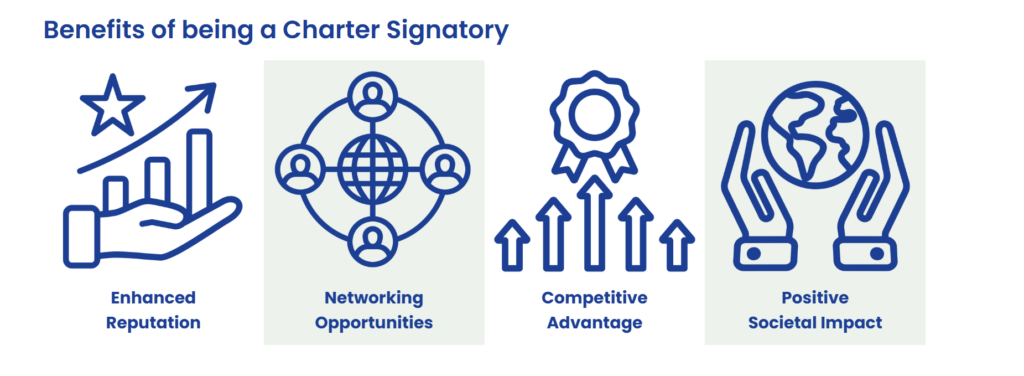
As the Charter builds momentum, we invite more organisations to contribute to this collective effort.
Whether you are already advancing your ESG agenda or just starting your journey, the Charter offers an opportunity to align with industry-leading commitments to lead a stronger, more resilient future for the UK defence sector.
View more about the UK Defence ESG Charter.
Contact george.dietz@adsgroup.org.uk to discuss how you can get involved.